
For Your Home
Rebates for Home Solar Systems
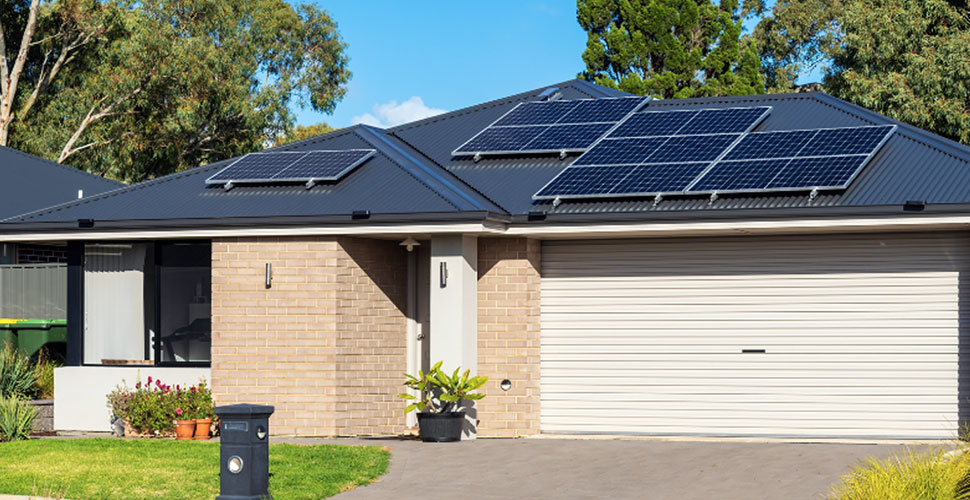
Are you ready to power up with sunshine? Austin Energy can help you invest in home solar installation.
How Austin Energy Supports Your Solar Journey
Austin Energy offers a $4,000 rebate for eligible home solar projects. Once your solar system is up and running, we also pay you for all power produced.
This Home Solar guide covers information you need to know about going solar with Austin Energy—from how solar works to what to expect as a customer. You’ll learn how to pick the right system, understand the installation process, and make the most of available rebates and bill credits. Read through this page to get started, then take our Solar Rebate Quiz to begin your rebate application.
Expand All
-
How Solar Works
Curious how solar works once it is installed on your home? This interactive guide breaks down how sunlight becomes electricity, how your home uses it, how excess energy is shared with the grid, and how solar is reflected on your bill.
-
Is Solar a Good Fit For Your Home?
Shade and Sunlight
For solar panels to work effectively, it is important that your roof gets direct sunlight for at least 5–6 hours a day. It's best if there are no large trees, chimneys or other structures shading your roof.
Solar panels perform best when facing south, with west and east facing systems.
Roof Size and Condition
To minimize maintenance, it’s recommended that your roof have at least 10 years of life left prior to installation. If your roof has damage or may need to be replaced soon, it is best to get it replaced before installing solar.
You'll need to have enough roof space for panels (typically 200-400 square feet).
Home Energy-Efficiency Upgrades
Installing solar can be a big investment. If you haven’t already, consider investing in making your home more energy efficient before installing solar panels.
- Take Austin Energy's Home Energy Quiz to find out if your home qualifies for a no-cost, in-home energy assessment.
- Learn about all of Austin Energy's home energy-efficiency rebates & incentives
-
Understand Your Solar Bill & Estimated Payback
As an Austin Energy Residential Solar customer, you’ll continue to pay standard residential rates for the electricity your home uses.
You’ll also receive a monthly bill credit for the solar energy your system generates.
Austin Energy credits solar customers 12.89¢ per kilowatt-hour (kWh) for the energy you produce. We call this the "Value of Solar" rate. To learn more, check out our Value of Solar rates page.
Here’s how solar shows up on your monthly electric bill:
- Solar Meter Read: How much energy your solar panels produced
- Revenue Meter Delivered Read: Energy your home used from the grid
- Revenue Meter Received Read: Energy your solar system sent back to the grid
- Value of Solar Bill Credits: The amount you're credited for your solar production
Interactive Residential Solar Bill Explainer
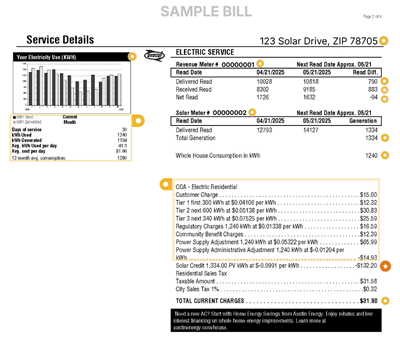
Learn what different line items mean and how the Value of Solar rate affects your bill.
If you produce more credits than you use, they roll over to the next month. Please note that Value of Solar bill credits apply only to your electric charges, not to other services like water or trash.
Figuring Out Your Payback Period
Estimated Payback Periods are typically calculated by dividing the net total cost of your system by your total estimated savings from solar. At Austin Energy, your 'estimated savings' should be based on the 'estimated earnings' you will receive from Value of Solar bill credits.
Here’s what to consider:
- Upfront cost/monthly payment (for leases): If you are leasing or are purchasing with a loan, make sure to include any required annual payment increases through the life of the system.
- Monthly Value of Solar bill credits: The credits you earn will be based on the Value of Solar rate, which is updated every three years to reflect market conditions. Make sure your solar installer tells you what rate assumption they are using for year one, and at what rate they are assuming it will increase.
- Generation over the life of the system: It is natural for a solar system to generate less energy over time. However, sometimes production is lower because system issues impact performance. Make sure to understand your contractor’s performance guarantee, and how it may affect you financially.
- Maintenance: Solar systems are low maintenance, but you may still have some upkeep over time. When you own a solar system, the responsibility for maintenance is yours. If you are leasing the solar equipment, make sure to understand who is responsible for maintenance, what documentation is needed to initiate repairs with the leasing company, and who to contact for maintenance questions.
- Roof condition: It’s recommended to fix any roof issues ahead of installing solar, especially if the roof is nearing the end of its lifespan.
-
Choosing the Right System Size
One of the first things a contractor may ask for is your electric bill. This helps them figure out what size solar system is right for your home. "System size" typically refers to the cumulative power rating (kW) of the solar panels. To estimate how much energy your system could generate in a year, you can enter the system size (in kilowatts or kW) into the PVWatts Calculator.
Adjust the Size of Your Solar System According to Your Energy Needs
- It’s perfectly acceptable to install a solar array that doesn’t meet 100% of your energy demands.
- Consider sizing your system to match your annual energy needs; this approach will help neutralize your carbon footprint.
- If you choose to oversize your system, be aware that you cannot cash out excess solar credits.
Request Multiple Quotes from Approved Contractors
Find out more in the How to Choose a Contractor section. Be sure to get quotes and sizing recommendations from multiple contractors.
-
Consider Battery Backup for Outage Resiliency and Demand Response
Solar panels alone won’t keep your lights on during a power outage.
If there’s a power outage, your solar system will automatically shut off to keep utility crews safe while they make repairs.
To keep your home powered during an outage, consider adding a battery to your solar system.
Talk to your contractor about how much backup power you need—this depends on what you want to keep running, and for how long, during an outage.
- Take Austin Energy's Outage Prep Knowledge Check
- Explore outage prep tips and resources to stay ready in case the power goes out
Customers that install batteries can earn performance rewards with Austin Energy's new demand response pilot program, Power Partner Battery. When you enroll in Power Partner Battery, you allow Austin Energy to use stored energy from your battery during periods of high demand. Power Partner Battery participants help maintain a more resilient energy grid and reduce the need to build new power plants. Check out the Power Partner Battery page to learn more about eligible equipment and how to become a Power Partner.
-
How to Choose a Contractor and Compare Proposals
Only participating solar contractors are eligible to offer Austin Energy solar rebates and incentives. (All participating contractors must abide by the Austin Energy Code of Conduct and Ethical Requirements (pdf) and the Austin Energy Solar Program Contractor Handbook (pdf) to remain on our participating contractors list.)
You may choose to use a solar company that is not listed, but they cannot offer Austin Energy solar incentives. Austin Energy recommends that customers check contractor references and obtain at least three quotes prior to selecting a solar installer.
Consumer Protection Tips
- Before you start your search, check out our Tips for Avoiding Pitfalls and Selecting a Contractor to stay safe.
- Be careful with online forms that may sell your information to robocallers.
- Use a separate email address for your solar search. For example: solarfor123MainStreet@email.com. This helps you keep solar quotes organized and protects your main inbox from spam.
- Report issues to the Texas Department of Licensing and Regulation.
- Make sure that your proposal is not a Power Purchase Agreement (PPA) style lease. Power Purchase Agreements (PPAs) for residential customers to buy energy from a third party are not allowed within Austin Energy territory.
Tips for Collecting Proposals and Choosing a Contractor
 Use an installation contractor from the Austin Energy Participating Solar Contractors directory. Please note, Austin Energy does not regulate financial companies providing loans or leases associated with solar systems.
- Use this interactive explainer to understand what's included in a typical solar proposal and to ensure it accurately reflects utility rates.
- Refer to our helpful Questions to Ask Solar Contractors one-pager (pdf) for guidance on choosing a reputable contractor.
Make Sure Each Bid Proposal Includes:
- System Specifications
- System size (in kilowatts/kW)
- Expected annual energy production (in kilowatt-hours/kWh)
- Cost and Payments
- Total cost before and after rebates and tax incentives
- Payment schedule tied to installation milestones
- Payment methods, fees, and annual increases
- Process for sale-of-home/change of ownership for loans or leased systems
- Equipment Details
- Complete list of included components:
- Solar panels and mounting racks
- Inverters and monitoring tools
- Batteries (if applicable)
- Complete list of included components:
- Warranty Information
- Installer warranty covers workmanship and installation damage
- Manufacturer warranty covers equipment defects
- Be sure to get warranty documents from your installer to keep for your records
- Performance Guarantee covers differences in generation from production estimates and over the years
- Not typically covered:
- Routine panel cleaning
- Weather damage (hail, falling branches)
- Future tree trimming/vegetation management
- Future re-roofing costs
- Check with your homeowner's insurance for additional coverage options
Key Numbers to Pay Attention To:
- Price per Watt ($/W)
This tells you how much the system costs based on its size.
Formula: Total system cost ÷ system size (in watts)
Things like electrical upgrades, batteries, warranties, or extras like critter guards and smart home features can increase this number. - Estimated Annual Energy Production (kWh/year)
Make sure the system’s expected yearly output matches your energy goals. - Price per Kilowatt-Hour ($/kWh)
This helps you understand your long-term value.
Formula: Total system cost ÷ total energy the system is expected to generate over its lifetime
You can use the full warranty period or choose a shorter time frame for this calculation. - Inflation Rate
- Production Factor
This measures how efficiently your system will produce energy.
Formula: Estimated annual production (in kWh) ÷ system size (in kW)
In Austin, a good range is 1,100 to 1,500 kWh per kW.
Factors that affect this include:- Roof direction (south-facing is ideal)
- Roof slope
- Shade from trees, buildings or roof features
- Equipment efficiency
Equipment and Warranties
What to Look for in a Solar Proposal Note the following for each quote: Factors to consider when comparing solar proposals: Annual Escalator Loan and lease payment terms may not be at a flat rate. Look for the yearly rate of increase. Compare the maximum payment amount that you would be making each month in the final year.
Annual escalator can also apply to the estimated increase to your Value of Solar bill credits.
Estimated generation Price-per-kilowatt hour ($/kWh) Storage capabilities Battery capacity in kWh and kW, and how long the backup will last
System components / capabilities Batteries, monitoring, service upgrades System size and value
Price-per-watt ($/W)
TDLR License Number Use our Questions to Ask Solar Contractors (pdf) one-pager, and check online reviews
Total price and payment schedule Upfront vs. completion payments, interest rates, incentives Warranty Length of manufacturer and installer coverage -
System Operation and Monitoring
- Most systems come with a monitoring app. However, you can also use Austin Energy’s free Solar Insights tool (available when you log into your account on COAUtilities.com) to see your solar generation.
- Once your system is up and running, you’ll start earning Value of Solar (VoS) credits on your monthly bill. Check out our interactive billing explainer to see how these credits will appear.
-
Available Incentives to Go Solar
If You Want to Own Your Solar Panels
Available Incentives:
- Austin Energy Residential Solar Rebate: You can earn a $4,000 rebate by completing our Solar Rebate Quiz (based on this webpage) and installing a qualifying solar system on your home using a participating solar contractor.* Learn more below.
- Value of Solar Bill Credits: Austin Energy credits residential solar production at the current Value of Solar Rate of 12.89 cents per kWh. Learn more about how customers are billed.
- Property Tax Exemption: Your solar system may qualify for a property tax exemption. Learn more from the State Comptroller Office.
*All solar systems will automatically receive Value of Solar bill credits.
-
Meet the Eligibility Requirements
Prerequisites
- You must have an Austin Energy residential electric utility account. The solar system must be installed at the premise connected to your Austin Energy residential electric account.
- Your solar system must be new and cannot be installed prior to rebate submission.
Requirements
- You must use an Austin Energy Participating Contractor to install your solar system - see participating solar contractors.
- The solar system must be 3kW (DC) or larger, and mostly free of shading.
- You must apply for and receive an Austin Energy Solar Rebate Confirmation Letter prior to system installation to be eligible for Austin Energy rebates and incentives.
Exclusions
- Third-party solar Power Purchase Agreements (PPAs) are not allowed in the Austin Energy service territory.
-
How to Apply for Austin Energy's $4,000 Rebate
Follow these steps to apply for your $4,000 rebate:
Take the Solar Rebate Quiz and Hire an Approved Contractor
- After reading through this page, take our Solar Rebate Quiz linked at the bottom of this section.
To take the quiz, be prepared to provide your:
- contact information
- electric utility account number (found on your electric bill)
- address
- Upon quiz completion, you will receive a rebate reference number. Keep this number for your records.
- Hire a participating Austin Energy solar contractor. You will NOT receive a rebate if you hire a contractor who is not on our approved list. Austin Energy highly recommends getting at least three quotes before hiring a contractor.
- Give your rebate reference number to your chosen participating solar contractor. They will use this number to apply for the rebate on your behalf.
Documentation and Installation
- Your contractor will provide you with two forms for review and signature:
- Residential Interconnection Agreement Form (pdf) (required for all residential solar installations whether rebated or not)
- Customer Agreement Form (pdf) (CAF; required for all rebated residential solar installations)
- Await your rebate confirmation letter. Ensure you receive this letter before your system is installed.
- Solar system installation begins.
Inspection and Getting Your System Turned On
- When the system is installed and ready, your contractor will schedule a final solar inspection.
- Upon passing inspection, Austin Energy will install the required solar meter . Once installed, you have Permission to Operate (PTO), and your system can be turned on!
- Also upon passing inspection, you and your contactor will get an email confirming that your rebate has moved onto the final step for processing—Quality Assurance (QA) review.
- After QA Review approval, the rebate check is mailed. Please allow 7–10 business days for the check to arrive.
Get Started: Take our Solar Rebate Quiz
- After reading through this page, take our Solar Rebate Quiz linked at the bottom of this section.
To take the quiz, be prepared to provide your:
-
Documents
- Residential Solar Rebates Guidelines and Customer Agreement Form (CAF) (pdf)
- Residential Solar Rate Schedule (pdf)
- Residential Solar Interconnection Agreement Form (pdf)
Learn More About Shopping for Solar
- Solar Photovoltaic System Installation Steps (pdf)
- Austin Energy Customer Guide: Questions to Ask Solar Contractors (pdf)
- En Español: Guía del cliente de Austin Energy: Preguntas para realizar a los contratistas solares (pdf)
- Check out the Considering Installing Solar Panels at My Home guide from the Public Utilities Commission.
Expand All
Is Subscription Renewable Energy Better for You?
You can also choose to harness Texas wind and solar power at a smart, convenient price with GreenChoice® Renewable Energy.
Learn More
- Solar Ready Checklist (pdf)
- En Español: Lista para Energía Solar (pdf)
- Texas Department of Licensing & Regulation Solar Panel Consumer Protection Guide (pdf)
- Austin Energy Customer Guide: Questions to Ask Solar Contractors (pdf)
- En Español: Guía del cliente de Austin Energy: Preguntas para realizar a los contratistas solares (pdf)
- Understanding Your Residential Solar Utility Bill (pdf)
Contact Us
Date last reviewed or modified: 10/01/2026